Tartarus brings Caged Beasts, prison Riots, and recruitable Followers to Torchlight Infinite Season 14. Alongside these systems, Youga’s new Hero Trait, The Ultimate One, introduces a different way to fight using the Clockwork Core.
The practical goal is straightforward: create worthwhile encounters, finish them consistently, and choose upgrades that solve your character’s actual weaknesses.
Key Takeaways
- Prison management has a limit of 20 in-game days, not real-world days. Then you need to defeat your developed inmates in the RiotWhen management ends, your developed inmates become the combat challengeEnds when all inmates are defeated or your revives run outThen open the activated caches in the reward room to activate their Warden’s CachesActivated by defeating inmate groupsRarity corresponds to the inmate group defeatedOpened in the reward room after the encounterSome seasonal Compasses increase their drops but make monsters harder to kill.
- Start with a low-investment baseline and test one Compass setup at a time. A larger drop multiplier is not automatically a better farming setup.
- Tartarus introduces four Follower groups: Lone Wolf, Mammoth, Witch Rat, and Lion Queen. Choose a Follower and compatible skill that address one specific problem in your build.
- Youga’s new Hero Trait, The Ultimate OneYouga’s new Hero TraitClockwork Core supports a main active spell compatible with TanglesNon-main skills cannot be tangled or trigger Spell BurstBased on current pre-release trait data, is built around the Clockwork Core. Check a build’s main-skill compatibility before following it.
- Spend Flame Elementium on your current bottleneck, and avoid using your entire reserve on a speculative item while your basic setup remains unfinished.
For general advice on choosing an affordable starter, see MmoGah’s Torchlight Infinite season-start tips.
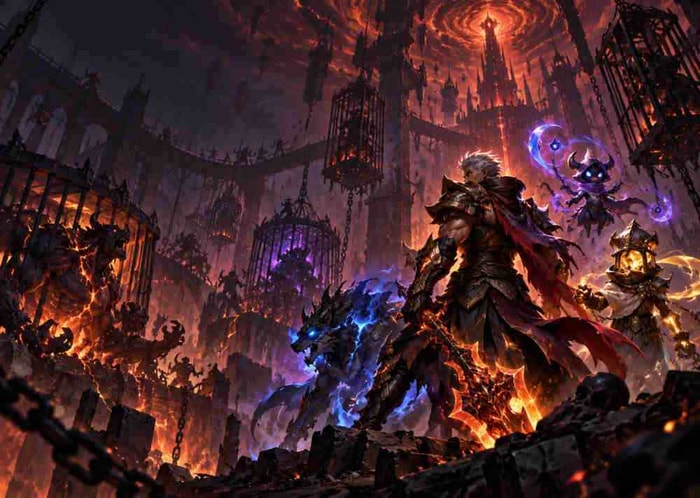
Tartarus-inspired illustration; not an in-game screenshot.
⛓️ How the Tartarus Mechanic Works
Collect Inmates in the Netherrealm
Defeat escaped inmates during Netherrealm exploration and collect their nameplates. Accumulating enough lets you begin a prison-management round.
Develop Your Prison Board
The management phase has a limit of 20 in-game days, rather than 20 real-world days. Inmates increase their rarity by consuming targets they counter at the same rarity. Torture instruments and prison events provide additional ways to influence development.
Warning: Before committing a move, check both the counter relationship and rarity. Do not assume that placing two identical-looking pieces together produces an upgrade.
As a starting approach, prioritize valid upgrades you can complete now over elaborate chains that depend on several lucky future outcomes.
Suppress the Riot and Open Your Caches
When management ends, your developed inmates become the combat challenge. Defeating inmate groups activates Warden’s Caches of corresponding rarity.
The encounter ends when all inmates are defeated or your revives run out. You then access the reward room and open the caches already activated.
Building a valuable prison is only half the job: you still need to defeat its inmates to unlock their rewards.
⚔️ Start with Low-Investment Tartarus Runs
Some seasonal Compasses increase the quantity of items dropped by Warden’s Caches while making monsters harder to kill. For example, Mercury ShacklesSeasonal CompassImproves Warden’s Cache loot quantityReduces the damage monsters take during the Riot improves cache loot quantity but reduces the damage monsters take during the Riot. Equipped Season Compasses are consumed when the endgame stage begins.
Start with a low-investment baseline:
- Run the content without expensive modifiers.
- Record completion time, deaths, and rewards across several attempts.
- Test one Compass setup at a time against your baseline.
- Keep it only when the extra rewards justify its cost and the longer fight. A larger drop multiplier is not automatically a better farming setup.
If repeated deaths stop your runs, fix survivability first. If you survive comfortably but encounters drag on, investigate damage uptime and single-target performance before increasing investment.
🐾 Followers: How to Choose and Develop Them
Choose Followers That Support Your Build
Tartarus introduces four Follower groups: Lone Wolf, Mammoth, Witch Rat, and Lion Queen. You obtain them through seasonal gameplay. Their quality affects available skill slots and active skills, while their exclusive Tartarus SkillsExclusive to FollowersCan buff allies or debuff enemiesFollower quality affects available skill slots and active skills can buff allies or debuff enemies.
Start by identifying one problem: unreliable recovery, slow attacks, weak critical damage, or missing damage support. Then look for a Follower and compatible skill that address it.
Follower skill compatibility matters. For example, the published skill data associates Life TonicFollower-only Tartarus version: life regeneration and conditional recovery at low lifeAssociated with Lone Wolf and Mammoth in the published skill data and Charging WarcryFollower-only Tartarus version: an attack-speed buffAssociated with Lone Wolf and Mammoth in the published skill dataNot a substitute for cast speed on a spell build with Lone Wolf and Mammoth, while Splitting Lightning BoltFollower-only Tartarus version: applies Mark, increasing the target’s critical damage takenAvailable to Lion Queen and Witch Rat in the published skill data is available to Lion Queen and Witch Rat.
Match Tartarus Skills to Your Build
The examples below refer to the Follower-only Tartarus versions of these skills. Use them to identify effects that support your build, rather than as a universal Follower ranking.
| What your build needs | Tartarus Skill to investigate | Relevant benefit |
|---|
| Life recovery | Life Tonic | Life regeneration and conditional recovery at low life |
| Faster attacks | Charging Warcry | An attack-speed buff |
| Critical-hit support | Splitting Lightning Bolt | Applies Mark, increasing the target’s critical damage taken |
| Fire-damage support | Blazing Meteor | Applies enhanced Fire Infiltration |
These effects are described in the published SS14 patch notes.
Warning: Do not select a support effect simply because its number looks impressive. Check whether your main damage actually benefits from it. An attack-speed buff is not a substitute for cast speed on a spell build.
Also test the effect in combat. Watch whether your Follower applies it to the enemies that matter and whether it remains useful during boss encounters, not just while clearing small packs.
Temper Useful Skills Before Chasing Perfect Rolls
Tempering MedalsAdd a random General Support Skill to an empty affix slot on a Tartarus SkillOrigin Tartarus Skills use their corresponding Origin medalThe result is random: optimization, not a guaranteed fix add a random General Support Skill to an empty affix slot on a Tartarus Skill. Origin Tartarus Skills use their corresponding Origin medal, with a different support pool.
Because the result is random, treat tempering as optimization rather than a guaranteed fix.
First secure the active skill and compatibility you need. Then inspect its existing supports and empty slots before spending materials. Avoid investing heavily in a temporary skill solely because it has room for more modifiers.
🌀 Youga — The Ultimate One: What to Check Before Starting
The Ultimate One is Youga’s new Hero Trait, built around the Clockwork Core.
According to the current pre-release trait data, Clockwork Core supports a main active spell that is compatible with Tangles, taking the place of the support skill assigned to its second support slot. Non-main skills cannot be tangled or trigger Spell Burst.
Before following a build, check its main-skill compatibility and plan your remaining support choices around this requirement. Watch how the build relocates its Core between packs and handles moving bosses.
Choose this trait because you enjoy its playstyle and have a clear progression plan—not just because it ranks highly on a pre-season tier list.
🎯 Season Start Tips: Build a Reliable Progression Plan
Choose a Starter for Your Budget
A general tier list is not the same as a low-budget starter guide. A ranking that mixes early progression and heavily invested endgame builds cannot tell you how smoothly a character develops with ordinary gear.
Look for a guide with a leveling setup, affordable equipment alternatives, and a clear transition into its main farming configuration. Check which items are mandatory and which are simply upgrades.
For an established build, compare its hero trait, main skill, and essential equipment against the SS14 patch notes. The update includes changes across these systems, so checking one headline nerf is not enough.
Tip: Prefer a setup whose next upgrade you understand. A modest build with a clear progression path is a more useful starting plan than a showcase you cannot reproduce.
Check Season Rewards Before Spending
The season page advertises a Legendary Drop Pactspirit Selection Pack, an objective-based Base Activation Medium Selection Chest, and additional event rewards.
Check eligibility and objective requirements before spending on something those rewards could supply. Read the available choices before opening selection chests; do not assume every reward is immediate or offers every item.
Spend Flame Elementium on Your Current Bottleneck
Keep separate budgets for essential upgrades, farming costs, and experiments. Avoid using your entire Flame Elementium reserve on a speculative item while your basic setup remains unfinished.
For example, write down three intended purchases before browsing:
- One upgrade that enables your main skill.
- One that addresses your most frequent deaths.
- One optional improvement, which you buy last.
After each purchase, repeat comparable content and check what changed. Did you finish faster, die less, or maintain damage more consistently? Use those results—not the item’s rarity or a streamer’s spending level—to choose your next upgrade.
Short on Flame Elementium for your next essential upgrade? Write down your intended purchases first, then top up your reserve for the one that solves your current bottleneck.
Buy Torchlight Infinite Flame ElementiumFAQ
How does the Tartarus mechanic work in Torchlight Infinite?
Defeat escaped inmates during Netherrealm exploration and collect their nameplates; accumulating enough lets you begin a prison-management round, which has a limit of 20 in-game days. When management ends, your developed inmates become the combat challenge, and defeating inmate groups activates Warden’s Caches of corresponding rarity. The encounter ends when all inmates are defeated or your revives run out, and you then open the activated caches in the reward room.
How do inmates increase their rarity in Tartarus?
Inmates increase their rarity by consuming targets they counter at the same rarity, and torture instruments and prison events provide additional ways to influence development. Before committing a move, check both the counter relationship and rarity: do not assume that placing two identical-looking pieces together produces an upgrade.
Are seasonal Compasses worth using in Tartarus?
Some seasonal Compasses, such as Mercury Shackles, increase the quantity of items dropped by Warden’s Caches while making monsters harder to kill, and equipped Season Compasses are consumed when the endgame stage begins. Test one Compass setup at a time against a low-investment baseline, and keep it only when the extra rewards justify its cost and the longer fight.
What are the Followers in Torchlight Infinite Tartarus?
Tartarus introduces four Follower groups: Lone Wolf, Mammoth, Witch Rat, and Lion Queen. You obtain them through seasonal gameplay; their quality affects available skill slots and active skills, and their exclusive Tartarus Skills can buff allies or debuff enemies.
What do Tempering Medals do?
Tempering Medals add a random General Support Skill to an empty affix slot on a Tartarus Skill, while Origin Tartarus Skills use their corresponding Origin medal, with a different support pool. Because the result is random, treat tempering as optimization rather than a guaranteed fix.
What is The Ultimate One, Youga’s new Hero Trait?
The Ultimate One is Youga’s new Hero Trait, built around the Clockwork Core. According to the current pre-release trait data, Clockwork Core supports a main active spell that is compatible with Tangles, taking the place of the support skill assigned to its second support slot. Non-main skills cannot be tangled or trigger Spell Burst.


