For many players in Diablo 4, the endgame grind has started feeling strange.
Your gear looks good.
Your build guide is correct.
Your Paragon board is finished.
Your Mythic Unique luck may even be decent.
Yet your damage still feels nowhere near what high-end players are showing on leaderboards.
The reason is that many players are no longer being limited by basic gear progression.
They are being limited by how they use the Horadric Cube.
And right now, one specific crafting mistake is quietly destroying the power ceiling of countless Season 13 builds.
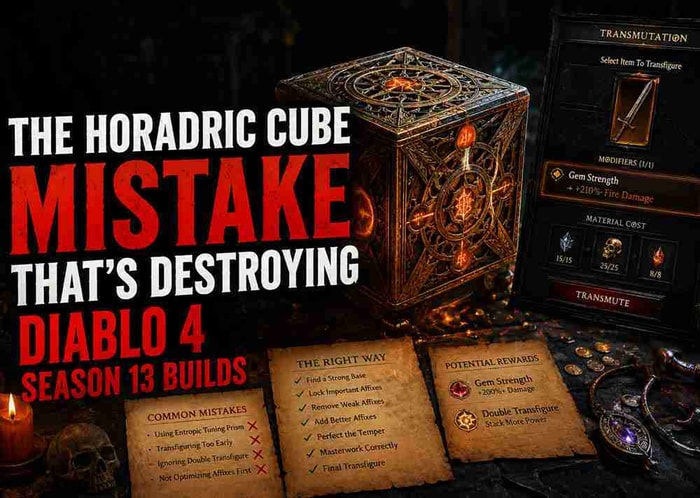
Most Players Are Transfiguring Weapons the Wrong Way
The biggest mistake many players are making is using Entropic Tuning Prisms on weapons.
At first, this seems logical.
Most players want:
- safe outcomes
- predictable crafting
- fewer ruined items
So they use Entropic Tuning Prisms to stabilize their transfigures and avoid bad outcomes like useless modifiers or unmodifiable items.
The problem is that this “safe” strategy also blocks some of the strongest weapon outcomes currently possible in Season 13.
That includes one of the most powerful transfigure effects in the game:
Gem Strength
This modifier massively increases the power of gems socketed into the weapon.
For some builds, this creates absurd scaling.
A Fire Damage gem that normally grants around 24% multiplier scaling can suddenly become massively amplified through Gem Strength transfigures, resulting in damage increases that can completely change a build’s performance.
This is one reason many top leaderboard players are suddenly dealing double-digit or even triple-digit trillion damage.
And here is the important part:
You can only get these high-end outcomes by transfiguring weapons raw.
That means:
- no Entropic Tuning Prism
- no safe crafting
- full RNG risk
Many players never realize this and unintentionally cap the potential of their own builds.
Why High-End Players Gamble Weapons Instead of Playing Safe
The Horadric Cube in Season 13 is no longer just a utility system.
It has become one of the most important endgame power systems in Diablo 4.
Top players are now repeatedly crafting and destroying weapons trying to hit:
- Gem Strength
- perfect multipliers
- double transfigures
- Greater Affixes
- ideal temper combinations
This process is extremely expensive.
A single weapon attempt may involve:
- rerolling affixes
- removing affixes
- adding Greater Affixes
- temper resets
- masterworking
- socket optimization
- aspect optimization
- final transfigure RNG
And if the final result is bad?
You destroy the weapon and start over.
This is one reason Diablo 4 Gold feels more important in Season 13 than ever before.
The deeper players push into endgame optimization, the more the game starts revolving around:
- crafting resources
- reroll costs
- Forgotten Souls
- repeated weapon attempts
- high-risk Cube transfiguring
For many players, the real endgame is no longer simply farming loot.
It is surviving the economy of endless crafting.
The Hidden Power of Double Transfiguring
Another mechanic many players still do not understand is double transfiguring.
Normally, players assume a transfigured item becomes permanently locked.
But raw transfiguring without an Entropic Tuning Prism sometimes allows a weapon to remain modifiable after the first transfigure.
This creates the possibility of:
- adding another modifier
- stacking even more scaling
- creating truly endgame-tier weapons
The chance is low, but the potential reward is enormous.
This is exactly why many high-end players avoid safe crafting on weapons entirely.
The risk is brutal.
But the payoff can nearly double a build’s damage output.
How Smart Players Prepare Weapons Before Transfiguring
One of the biggest mistakes casual players make is attempting final transfigures too early.
Experienced players first optimize the weapon completely before taking the final risk.
That usually means:
Step 1 — Find a Strong Base
Players typically target:
- Greater Affix weapons
- strong damage multipliers
- critical strike scaling
- class-specific offensive stats
Many players gamble bases through:
- Purveyor of Curiosities
- vendors
- forged rare weapons
- Torment farming
Step 2 — Lock Important Affixes
Players use enchanting to protect critical Greater Affixes before modifying the weapon further.
This prevents accidentally destroying the best stat on the item.
Step 3 — Remove Weak Affixes
Unwanted stats are stripped away while preserving the important multiplier stats.
Step 4 — Add Better Affixes
Players repeatedly add and remove affixes until they hit:
- weapon damage
- critical damage
- maximum life
- powerful multipliers
This alone can consume huge amounts of materials and Diablo 4 Gold.
Step 5 — Perfect the Temper
Many high-end players now refuse to settle for weak tempers.
They continue rerolling until they hit:
- Greater Temper outcomes
- ideal scaling rolls
This is another massive resource sink in Season 13.
Step 6 — Masterwork Correctly
Masterworking matters far more now because the correct critical hit can massively amplify:
- damage multipliers
- tempers
- scaling stats
One wrong Masterwork hit can drastically lower the final value of a weapon.
Step 7 — Apply the Final Aspect
Most players only attempt final transfigures once:
- the aspect is max rolled
- sockets are finished
- the weapon is completely optimized
Because once the final transfigure fails, the process often starts all over again.
Why Armor and Amulets Are Different
One of the most misunderstood parts of the Horadric Cube system is that weapons, armor, and amulets should not be crafted the same way.
Weapons
Most top players now avoid Entropic Tuning Prisms entirely on weapons because the strongest offensive outcomes require raw transfiguring.
Armor
Armor is different.
Many players prefer safer outcomes here because:
- defensive pieces are harder to replace
- stat combinations matter more
- failed RNG is more punishing
For normal armor pieces, safer prism crafting is often more reasonable.
Amulets
Amulets are currently one of the most difficult items to perfect in Season 13.
A good amulet may require:
- multiple damage multipliers
- perfect aspects
- high-quality affixes
- ideal transfigures
Because of how rare strong amulets are, many players choose safer crafting methods rather than risking total failure.
Others gamble aggressively for perfect outcomes.
Right now, the community is heavily divided on which strategy is better.
The Horadric Cube Has Become the Real Endgame
The deeper players go into Season 13, the clearer one thing becomes:
The Horadric Cube is no longer just a side crafting feature.
It is now one of the biggest factors separating average builds from elite builds.
Many players still think their weak damage comes from:
- missing Mythics
- bad luck
- low Paragon
- incorrect skills
But often the real issue is much smaller.
A weak transfigure.
A bad weapon gamble.
A missing multiplier.
A failed Cube decision.
And because the crafting system is so expensive, every mistake now costs huge amounts of:
- Diablo 4 Gold
- materials
- time
- resources
That is why understanding the Horadric Cube correctly may currently be one of the most important parts of progressing in Diablo 4.