Around Day 10 of Diablo 4 Season 13, many players are starting to hit the same problem. Their build looks correct, their gear score is high, and they already copied the strongest meta setups from top players. Yet their damage still feels far lower than expected in high Pit tiers or Torment 12 content.
The reason is usually not the build itself anymore. The real difference often comes from how players craft and combine damage multipliers on their gear.
Recently, advanced players discovered a new interaction between the Occultist and the Horadric Cube that allows you to preserve certain Greater Affixes while manipulating other stats through Focused Reroll, Remove Affix, and Categorical Rolling. This method has quickly become one of the most interesting endgame crafting strategies in Season 13 because it allows players to create gear with multiple multiplicative damage bonuses instead of relying on a single stat category.
This guide explains how the system works, how Tuning Prisms are used, and how players can strategically manipulate affix categories to create stronger endgame Diablo 4 items.
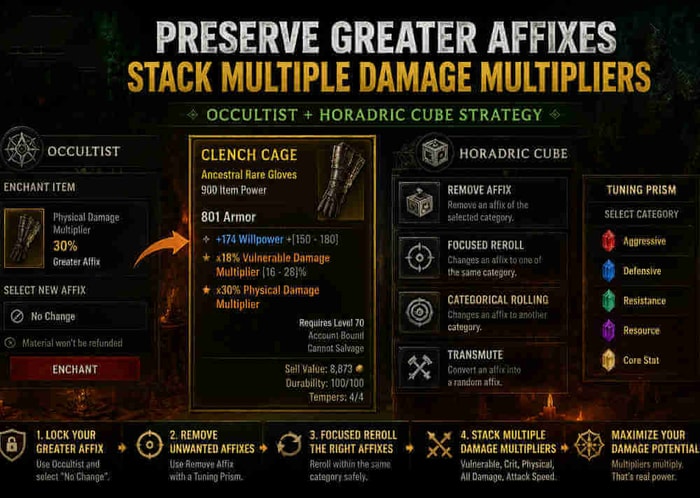
Why Multiple Damage Multipliers Matter
One of the biggest mistakes many Diablo 4 players make is stacking only one offensive stat category.
For example, some players try to stack:
- Critical Strike Damage
- more Critical Strike Damage
- even more Critical Strike Damage
The problem is that many of these bonuses become additive with each other. The damage number looks large on the character sheet, but the real performance increase becomes smaller over time.
The strongest endgame gear usually combines several different multiplier categories together, such as:
- Vulnerable Damage Multiplier
- Critical Strike Damage Multiplier
- Physical Damage Multiplier
- All Damage Multiplier
- Attack Speed
- Critical Strike Chance
These categories interact multiplicatively, which leads to dramatically higher real damage output.
That is why advanced crafters are now trying to create “triple multiplier” items instead of simply stacking one stat repeatedly.
Understanding the Horadric Cube Crafting System
The new crafting system revolves around manipulating affix categories through the Horadric Cube.
Several important systems work together here:
|
System |
Purpose |
|
Remove Affix |
Removes affixes from a chosen category |
|
Focused Reroll |
Rerolls an affix within the same category |
|
Categorical Rolling |
Converts affixes into another category |
|
Tuning Prism |
Determines which affix category is targeted |
|
Occultist Enchanting |
Used to “lock” Greater Affixes |
Understanding how these systems interact is the key to advanced crafting.
What Does a Tuning Prism Actually Do?
Tuning Prisms allow the Horadric Cube to target specific affix categories.
Instead of random rerolls, you can influence which types of stats are added, removed, or rerolled.
Different categories include:
|
Category |
Examples |
|
Aggressive |
Vulnerable Damage, Crit Damage, Physical Damage |
|
Defensive |
Armor, Maximum Life |
|
Resistance |
Fire Resistance, Shadow Resistance |
|
Resource |
Lucky Hit Resource, Resource Generation |
|
Core Stat |
Strength, Dexterity, Intelligence, Willpower |
This system gives players far more control over crafting than previous Diablo 4 seasons.
How to Preserve Greater Affixes
This is the most important discovery players recently found.
Normally, rerolling offensive stats risks destroying valuable Greater Affixes. This is especially painful on items that already rolled high-end stats like:
- Physical Damage Multiplier
- Weapon Damage
- Maximum Life
- Critical Strike Damage
However, players discovered a method that effectively “protects” one Greater Affix from future Horadric Cube manipulation.
Here is how the process works.
Step 1 — Prepare the Item
You first need an item with at least one valuable Greater Affix you want to preserve.
Example:
- Physical Damage Multiplier
- Weapon Damage
- Maximum Life
The item does not need to be perfect. In fact, this method is valuable because it allows weaker crafting bases to become usable.
Step 2 — Add a Temporary Affix
Before locking the Greater Affix, players usually add another affix using a Tuning Prism.
For example:
- Add an Aggressive affix
- Gain Willpower
- Gain Damage Over Time
- Gain Vulnerable Damage
Some of these temporary affixes are intentionally undesirable. They only exist to manipulate the affix pool later.
Step 3 — Use the Occultist to “Lock” the Greater Affix
This is the key interaction.
At the Occultist:
- Select the Greater Affix you want to preserve
- Begin the enchant process
- Choose “No Change”
Even though the stat does not visually change, the item appears to become internally flagged by the game.
After this interaction, the Greater Affix becomes effectively protected from many Horadric Cube rerolls.
This is why the method is so powerful.
Step 4 — Use Focused Reroll Strategically
Now the Horadric Cube behaves differently.
Because the Greater Affix is protected, Focused Reroll will usually target only the remaining affixes within the same category.
For example:
You preserve:
- Physical Damage Multiplier
Then reroll:
- Vulnerable Damage
- Attack Speed
- Crit Chance
without risking the Physical Damage Multiplier.
This allows players to cycle offensive stats repeatedly until they find strong multiplier combinations.
How Remove Affix Works
Remove Affix deletes an affix belonging to a targeted category.
This is controlled through Tuning Prisms.
Examples:
|
Prism Type |
Likely Target |
|
Aggressive Prism |
Offensive stats |
|
Defensive Prism |
Armor, Life |
|
Resistance Prism |
Resistances |
|
Resource Prism |
Resource stats |
This system becomes extremely powerful once a Greater Affix is protected because unwanted stats can safely be removed without risking the locked stat.
Example:
- Remove Willpower
- Remove Damage Over Time
- Remove Resistances
- Keep Physical Damage Multiplier safe
What Is Focused Reroll?
Focused Reroll changes an affix into another affix from the same category.
This is one of the strongest crafting systems for endgame optimization.
Example:
- Vulnerable Damage → Attack Speed
- Damage Over Time → Crit Chance
- Crit Chance → All Damage Multiplier
Because the reroll stays inside the category, players can repeatedly cycle toward desirable multiplier combinations.
This is how players create “perfect” offensive gloves, weapons, rings, and amulets.
What Is Categorical Rolling?
Categorical Rolling is more chaotic.
Instead of staying within a narrow affix pool, it can convert stats into broader categories.
This is especially useful for strange hybrid affixes like:
- Willpower
- Core Stats
- certain Defensive interactions
Interestingly, some stats belong to multiple categories simultaneously.
Willpower is one of the most unusual examples because it behaves as both:
- a Core Stat
- an Aggressive stat
This creates strange reroll behavior where some systems can target it while others cannot.
Advanced players are already using this interaction to manipulate double Greater Affix weapons more safely.
Example of a Strong Triple Multiplier Item
Gloves Example
A powerful endgame glove setup might contain:
- Vulnerable Damage Multiplier
- Physical Damage Multiplier
- Critical Strike Chance
- Attack Speed
This structure is extremely strong because each stat improves damage differently instead of stacking additively.
Example of a Strong Weapon
A weapon may contain:
- Weapon Damage
- Physical Damage Multiplier
- Critical Strike Damage
- All Damage Multiplier
This creates multiple independent scaling vectors for high-end Pit pushing.
The Biggest Limitation of This Method
This crafting strategy is extremely powerful, but it is not perfect.
The main limitation is:
You can realistically protect only one affix.
Once the item becomes more complicated, rerolling the fourth stat becomes risky again.
This means:
- bad rolls can still brick the item
- players may become trapped with undesirable stats
- resource costs become very high
The method improves consistency, but it does not create guaranteed perfect items.
Why This Strategy Is So Valuable in Season 13
The biggest advantage is not just preserving Greater Affixes.
The real advantage is this:
You no longer need perfect base items.
Previously, advanced crafting required nearly flawless drops before players even started crafting.
Now:
- weaker bases can be repaired
- bad affixes can be cycled away
- multiple multipliers can be built gradually
That dramatically lowers the barrier for high-end crafting.
Best Ways to Farm Tuning Prisms and Cube Materials
This strategy consumes massive amounts of materials.
The best sources currently include:
Nightmare Dungeons
Some Nightmare Dungeons contain material reserve chests that frequently drop:
- Tuning Prisms
- Primordial Dust
- Forgotten Souls
Undercity Runs
Using Horadric material tributes inside the Undercity is one of the fastest methods for stocking crafting resources.
War Plans
Higher-quality War Plan caches can reward large amounts of cube crafting materials.
If you plan to heavily reroll endgame gear, farming D4 materials efficiently becomes just as important as farming the gear itself.
Final Thoughts
This new crafting interaction between the Occultist and Horadric Cube may become one of the most important endgame discoveries of Diablo 4 Season 13.
More importantly, it teaches players something many never fully understood before:
The strongest Diablo 4 gear is not about stacking one giant damage number.
It is about combining multiple multiplier categories together while strategically preserving the affixes that matter most.
Players who understand how to manipulate:
- Tuning Prisms
- Remove Affix
- Focused Reroll
- Categorical Rolling
- Greater Affix preservation
will have a much easier time creating true endgame gear for Torment 12 and high Pit pushing.
Whether Blizzard eventually changes this interaction or not, understanding how affix categories and multiplier scaling work is already becoming one of the biggest differences between average builds and truly optimized endgame characters.