
PoE 3.30: The Claw Card Strategy – How to Double Your Viscera Drops
Learn how the Claw Card strategy, duplicate Fate Cards, and Empower mechanics can double your Viscera drops in Path of Exile 3.30.
There are a lot of new players, and even veteran players, who don’t know how to craft. With Path of Exile Delirium league just around the corner, Navandis Gaming shares with you a guide which aims to help you better understand the very basics of crafting. It contains some basic crafting methods that you can use to get much better value from your PoE Delirium currency and items. Navandis Gaming’s video has more details on the basic crafting guide in Path of Exile, and all the content of this article is quoted from his video:
Path of Exile items have 4 different rarities, and they are indicated by color:
This element dictates how many affixes an item can have. Normal items have no affixes. Magic items can have up to 2, and Rares can roll up to 6. Affixes are split between prefixes and suffixes. So, magic items can have at most 1 prefix and 1 suffix, but not two of the same kind. Rare items can have at most 3 prefixes and 3 suffixes, amounting to a total max of 6. This distinction is quite important because certain mod types are either prefixes or suffixes. For example, resistances are always suffixes, and so are attributes, such as dexterity or intelligence. This means on a rare item, you can have at most 3 resistance affixes, or 2 resistances and 1 attribute affix, but you can never have 3 resistances and an attribute affix as well. You also cannot have 4 resistance affixes either, for the same reason: you are limited to 3 suffixes. On the other hand, life is always a prefix, so you can have items with 3 resistances and some maximum life.
There is one additional mod on this item which I haven’t included earlier: it’s called an Implicit. It’s neither a prefix nor a suffix, so it doesn’t count towards that limit of 3 for each. Implicits are associated with certain base items, and they’re quite useful in crafting, as you are practically guaranteed to have at least that particular mod on the resulting item.
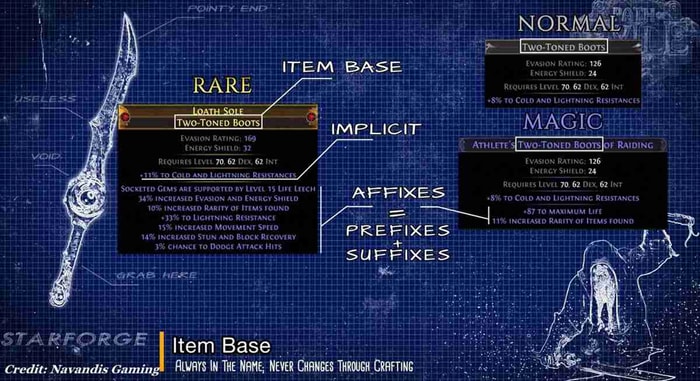
You can always identify the base of an item from its name, which in this case is Two-Toned Boots. The base of the item remains the same even if you craft it from normal rarity into magic, rare, or unique. And since the base doesn’t change, the implicit will also stay the same.
Items can also be what’s known as Shaper or Elder, identified by the cosmic or tentacle backgrounds respectively. These items generally drop on maps with Shaper or Elder influence.
An item with this extra property can also have certain affixes that are exclusive to Shaper or Elder items. For example, on these boots, “Socketed gems are supported by level 15 life leech” is a Shaper-exclusive affix and cannot be found on non-Shaper items.
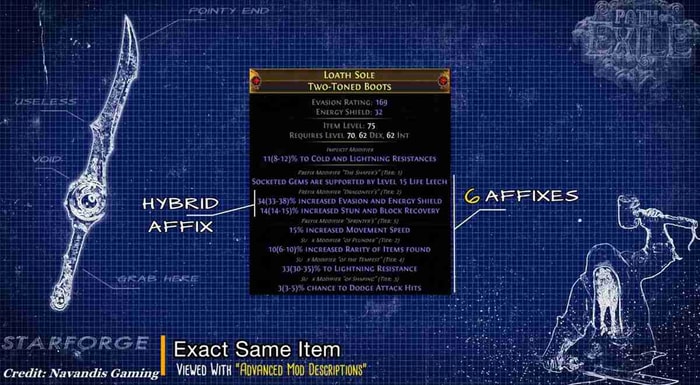
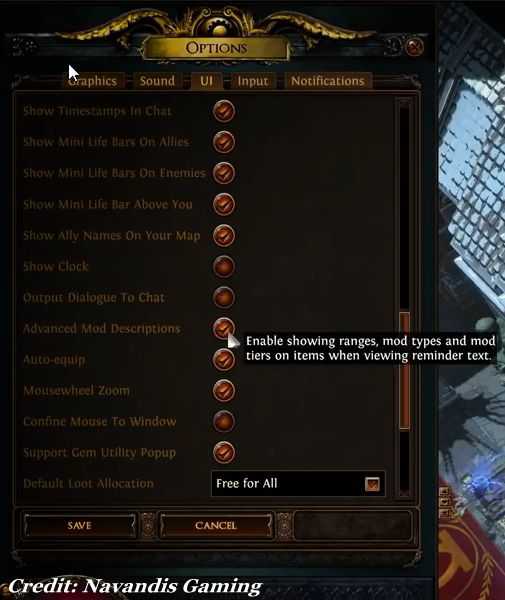
Now, it’s high time I addressed the elephant in the room and what looks like my complete inability to count: these boots look like they have, besides the implicit mod, 7 affixes. However, earlier I said that the maximum number is 6, so what’s going on there? Well, one of the affixes, “Dragonfly’s”, is what is called a Hybrid, and in fact adds two different modifiers. To get detailed information about any item, you need to go to Options → UI → and check the “Advanced Mod Descriptions” setting. After that, holding the “Alt” key while hovering the cursor over an item will bring up all this extra information. At a quick glance, you can more clearly see which is the implicit, the fact that the item has 3 prefixes and 3 suffixes, the name and the tier of each affix, as well as the possible numeric range of each mod.
So, how is this useful? Let’s take another item as an example: in the picture below, without looking at the advanced information, it seems like it has 7 affixes. Once expanded, it becomes obvious that, in fact, it only has 2 prefixes and 3 suffixes, which means that, through crafting, you can add another prefix, potentially making the item much more useful and valuable. Then you get the affix names and tiers.
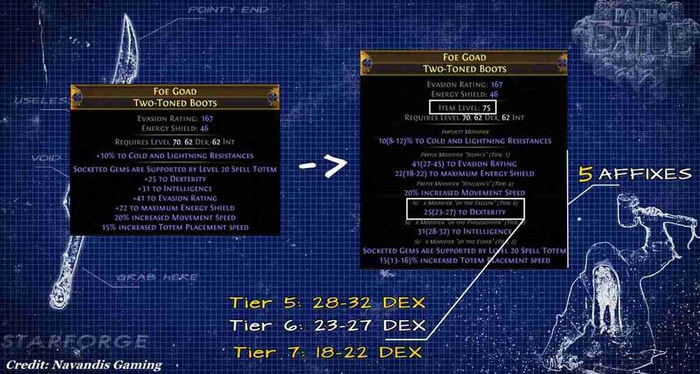
I will use the dexterity mod to exemplify this. It’s a suffix called “of the Falcon (tier 6)”. The tier is really important, and that is what determines the possible numeric ranges of an affix. The highest tier is 1, and the lowest can go all the way to 13. You can see that a tier 6 dexterity mod can roll a value between 23 and 27, but to better visualize how they work, there are a few additional tiers for this affix. The lower the tier number, the larger the affix values.
The item level is also important. This stat determines the possible range of tiers for each affix. Let’s continue with the previous example. Since the boots have an item level of 75, the highest possible tier for a dexterity affix is 2. You’d only be able to find tier 1 on boots with an item level equal to or higher than 82.
You don’t need to remember all these affixes and their tiers by heart. You just need to remember that tier 1 is the highest. The higher the tier, the larger the values are for an affix, and bigger item levels allow for higher tiers. There are also two excellent websites that I can recommend as references for item affixes: one is the Path of Exile wiki, the other is the mod page from poedb.tw. On either of them, you just need to select the item type, and you’ll get a list of all the possible affixes that can be found on it, along with their tiers and the minimum item level for each tier. If you are curious enough to go through a few of them, you’ll probably notice that some affixes can only be found on certain item types but not on others. For example, you’ll see that rings and amulets can roll spell damage, but this affix will never be found on body armor. And, while movement speed is mostly found on boots, it never rolls on gloves.
Now that you’re familiar with the items’ general structure, we can start looking at some basic crafting methods. The first and most obvious form of crafting is through the use of Path of Exile currency orbs. Each of these can transform items in a specific way, and the most basic currency orbs are the ones affecting item quality.
All three of these currencies can add up to 20% quality to each item. When applied to white items, the quality will increase by 5% with each orb, by 2% on magic items, and finally, by 1% on rares and uniques.
Tip: If you aim to start crafting from a white base item, it’s probably a good idea to use the quality orbs first.
Gemcutter's PrismIncreases the quality of skill gemsEach prism raises quality by 1% increases the quality of skill gems. Since these cannot have different rarities, each prism raises quality by 1%. Every gem gains a different bonus from quality, so you'll likely need to check the wiki page for the gems you want to improve to find out what you'll get.
The next several orbs are the ones used to upgrade items from one rarity to another:
None of these upgrade orbs will ever change the item base, the quality, the item level or the implicit. So if you use an Alchemy Orb on a pair of Bronze Gloves with 5% quality and item level 25, the result will be rare Bronze Gloves with 5% quality and item level 25. This is important for crafting: since the item level doesn't change, the possible affix tiers are already known. So, it will be better to use a high-level base to increase the chance of getting high-tier affixes and thus higher numbers. Or, if you want to get a certain unique item by using Chance orbs, then you have to use the same base item as the unique one you want.
Next, we are going to talk about orbs that remove or modify existing mods in certain ways.
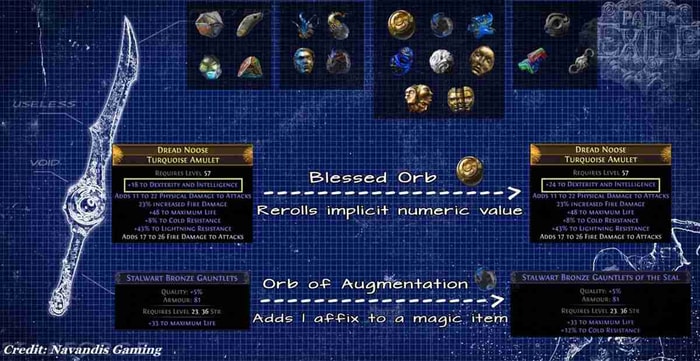
Blessed OrbRe-rolls the values of implicit modifiersWorks on all rarities, including uniquesRelatively cheap is a currency item used to re-roll the values of implicit modifiers on items that have one, and it works on all rarities, including unique items. It is relatively cheap, so it's really useful for min-maxing your gear and squeezing out something like a few more resistance points or life from items with implicits.
Orb of Augmentation adds an additional affix to a magic item that only had a single one.
Orb of Alteration can be used to re-roll the random mods on a magic item. You might get the same affixes again. It's not common, but it happens.
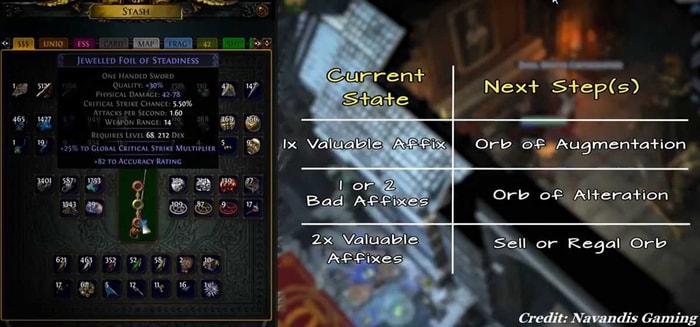
Transmutation orbs, Augmentation orbs, and Alteration orbs are very cheap, so they are often used together to craft a magic item with one or two very good affixes:
Depending on the base item and what you rolled on it, you might already have quite a valuable magic item that can be sold for a decent amount of currency.
For players who don’t want to use these tedious methods, you can use a Regal Orb on it, which will add one additional affix and transform it into a rare item, while of course retaining the two existing mods. So, let's pretend that these two affixes are what I was looking for: tier 1 or 2 lightning damage and crit. chance. The chances of getting a good, high-tier affix with the Regal Orb are quite low, but it can happen, and in such cases, the item's value increases tremendously. However, more often than not, you'll get a bad affix, as happened here. In that situation, you can use an Orb of Annulment, a rare and quite expensive piece of currency.
Orb of AnnulmentRandomly removes one affix from an itemRare and quite expensive randomly removes one affix from an item. So, when you have two great mods and a bad one, there's a 1 in 3 chance of being left with two good affixes. If you're lucky and you remove the mod you don’t need, you now have an even more valuable item than it was before upgrading from magic to rare. At that point, it can either be sold or further crafted using some more advanced methods that I won't be covering in this guide, but likely will in a future guide. However, in my case, I removed one of the good mods. So, the only real option is to use an Orb of Scouring and restart the crafting process.
Orb of Scouring can be used on a magic or rare item to remove all random mods. It does not affect the item's quality, implicit, enchants, sockets or links.
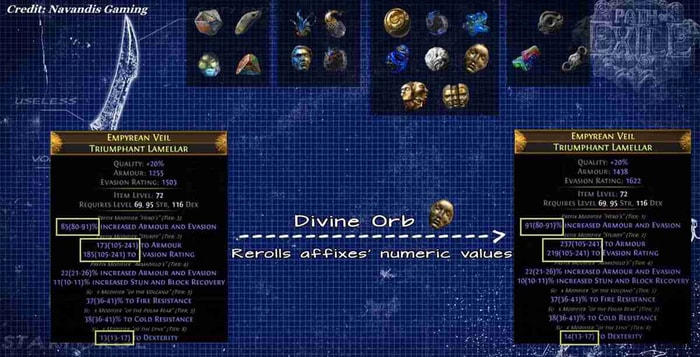
Using a Divine OrbRe-rolls the values of all affixes on an itemDoes not change the tiersUsed on very valuable items for min-maxing will re-roll the values of all the affixes on an item, and this will not change the tiers themselves. As you can see in the picture above, for most affixes, inside the same tier, the actual numeric value has a small variation range. On this armor, the tier 3 “Hero” prefix can have values between 80% and 91%. The tier 8 suffix, “of the Lynx”, can have between 13 and 17 Dexterity. After I used a Divine Orb, I got higher numeric values on most affixes, but the tiers remained the same as before. Generally, Divine Orbs are used on very valuable items for min-maxing. This also includes high-end unique items.
An Exalted Orb is a very expensive item crafting currency orb that can be used to add one new affix to a rare item that currently has fewer than 6.
Warning: Before you go adding random affixes to your items, keep in mind that an entire mid-tier gear set for pretty much all my builds costs around 7 to 10 Exalts. You're almost always better off buying decent items rather than adding a random affix to your existing equipment. It is a kind of gamble and might only pay off on items that are already extremely good.

Even in that situation, you can completely ruin them by adding a useless affix. The final crafting currency used to manipulate item mods is the Chaos Orb. Chaos Orbs simply re-roll the random mods on a rare item, both tiers and numeric values. It's a complete randomization of the item, so the results are unpredictable. Jewels, rings, amulets, maps and strongboxes are generally good options for chaos spamming. It's generally used on items that can roll a wide variety of useful affixes in a large number of combinations. This is one of the cheapest ways to craft because the Chaos Orb has a very low value. But it’s also one of the worst ways, since it’s just pure luck.
In Path of Exile, most items can have sockets where you put skill gems. These sockets can be linked, allowing the gems you put inside to influence each other in certain ways. Navandis Gaming’s beginners' guide helps you get familiar with this system.
The maximum number of sockets on any particular piece of gear depends on the item type:
| Item type | Maximum sockets |
|---|---|
| Shields and one-handed weapons | Up to 3 |
| Gloves, boots, and helmets | Up to 4 |
| Body armor and two-handed weapons | Up to 6 |
Jeweller’s Orbs randomly re-roll the number of sockets on an item within the limitations I've just mentioned. This also re-rolls the colors and links, since you can always obtain fewer sockets than you had before. One thing worth mentioning is that you can no longer apply Jeweller's Orbs to an item that already has its maximum number of sockets.
Orbs of Fusing re-roll the links on an item. The color and number of sockets remain unchanged. Somewhat similar to Jeweller's Orbs, you can’t apply any additional Fusing to a 6-link item. However, you can do it on a fully linked helmet, and that will simply re-roll all the links.
Tip: Item quality increases the chance of getting more links when using Fusing Orbs. So, do yourself a favor and improve the quality before attempting to link items.
The last currency item that affects sockets is the Chromatic Orb, which is used to re-color the sockets on an item. While white sockets exist in the game, they can’t be obtained by using Chromatics, as these can only roll red, green and blue. The resulting socket colors are not entirely random: sockets are more likely to roll a color corresponding to the attributes of the item being altered. Strength is associated with red sockets, Dexterity with green and Intelligence with blue.
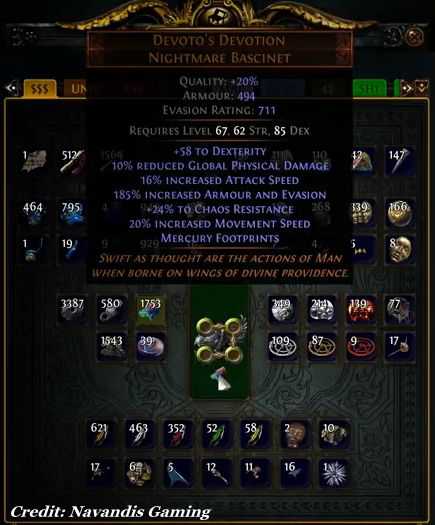
For example, this item's highest attribute requirement is Dexterity, followed by Strength and 0 Intelligence. That means it will have a high chance of rolling green sockets, a somewhat moderate chance for red, and a significantly lower chance of blue sockets. In this case, blue is what is called an off-color. This is especially important on 6-socket items, where it might be almost impossible or very expensive to obtain a large number of off-colors.
There's one additional basic crafting method: the hideout Crafting BenchUnlocked with your hideout from Helena after a quest in Act 2Adds a single affix to a magic or rare itemMore recipes come from various content. After you complete a quest in Act 2, the NPC Helena will grant you access to your own hideout, and probably the most important functionality of this area is the crafting bench. This can normally be used to add a single affix to a magic or rare item which has fewer than the max. By default, the bench comes with a few basic recipes, but you can find more by completing various types of content. Some can be found after unveiling items dropped by Syndicate members, others at certain depths in the Delve mine, and more esoteric ones in Incursion Temple rooms or after completing prophecies. While the affixes you can add this way have lower values than the naturally rolled ones, they are still a great way of improving your gear for a low cost.
Also, unlike the almost complete randomness of currency orbs, the crafting bench provides some degree of control and flexibility in customizing at least one affix on your items. For example, the ring I crafted earlier using Chaos Orbs had an empty prefix. So, it can be further improved by crafting something on it using the bench. For example, I could add some flat damage or minus mana cost, making it a good ring for a Cyclone build. If I use it, I can even replace that mod later with another crafted one, depending on what I need at that point. While the crafting bench has a lot of other functionalities, such as meta-mods, manipulating sockets and links, crafting corrupted items and so on, these are all more advanced topics. And there are of course quite a few other crafting methods, each with its own functionalities, and all can be combined with the basic methods to achieve different results.
If you have learned something new today, then give this video a like and share it with a friend. If it’s your first time here, it will be a good idea to bookmark our PoE news page for more content in the future. Don’t forget to check out MmoGah when you are looking to buy PoE items, because this is one of the best sites for any of your Path of Exile needs.
Rare items can roll up to 6 affixes: at most 3 prefixes and 3 suffixes. Magic items can have up to 2 (1 prefix and 1 suffix), and normal items have none.
Tier 1 is the highest, and the lowest can go all the way to 13. The lower the tier number, the larger the affix values, and the item level determines which tiers can roll.
Go to Options → UI → and check the “Advanced Mod Descriptions” setting, then hold the “Alt” key while hovering over an item to see the implicit, prefixes and suffixes, the name and tier of each affix and its possible numeric range.
It randomly removes one affix from an item. With two great mods and a bad one, there's a 1 in 3 chance of being left with two good affixes.
Usually not: you're almost always better off buying decent items rather than adding a random affix to your existing equipment. It is a kind of gamble that might only pay off on items that are already extremely good.
After completing a quest in Act 2, the NPC Helena grants you access to your own hideout, which holds the crafting bench. More recipes come from Syndicate members, Delve, Incursion Temple rooms and prophecies.
Learn how the Claw Card strategy, duplicate Fate Cards, and Empower mechanics can double your Viscera drops in Path of Exile 3.30.

In Path of Exile's 3.30 Covens of Umbra league, your build choice decides everything — whether you're a speed-farmer chasing raw PoE Currency per hour, or a hardcore raider lining up pinnacle boss kills. Below are five builds we've personally tested, iterated on, and confirmed clear the full endgame.

Original data from seven PoE leagues: a Divine Orb falls from $6.39 on launch day to $0.11 by week four. Chaos, Mirror, console prices and Covens of Umbra.

In Path of Exile 1's 3.30 "Covens of Umbra" league, the race to accumulate wealth and secure the ultimate chase item—the Headhunter—on day one is a top priority for every Exile.