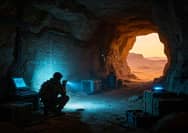
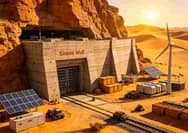
If you've seen that intro where the hand goes into the Gom Jabbar box, you already know what Dune: Awakening is saying from frame one: Arrakis does not keep dead weight. A beast will chew its own hand off to escape the pain — but the Sisterhood and the Mentats aren't looking for beasts. They're looking for human beings. In gameplay terms, that means the early game isn't about grinding mobs and watching numbers go up. It's about learning how not to die to the sun, the sandstorm, the worm, and plain old dehydration.

Below, based on a real solo run, we'll break down survival priorities, class/skill schools, base power management, and the discipline you need around Dune Awakening Solari.
1. First lesson: the red bar is scarier than the enemies
In the footage, SurvivalBob mentions he already put 300+ hours into the PC version last year, and this time he's back specifically for solo and private-server play. The reason is practical: on live multiplayer maps, everyone fights over the good spots, bases clog the landscape, trade runs get ganked, and PvP nerves burn out fast. Solo mode is closer to what Arrakis was always supposed to feel like.
The thing new players ignore most is the heat/sun exposure meter:
• Red → yellow → danger: roaming under the open sun drains you toward dehydration.
• Crossing exposed sand is basically ringing the dinner bell for a sandworm.
• Before you have a suspensor belt, don't go cliff-jumping — dying to fall damage is dumber than dying in a duel.
• Flowers give water, but only when you're desperate enough; you'll spend a lot of time living right on the edge of your water line.
Real takeaway: early on, the goal isn't "get stronger." It's "don't die." If you make it back to base alive, you've already made money.
2. Which skill school? Bene Gesserit is the safest start
The skill trees are Trooper, Mentat, Planetologist, Bene Gesserit, and Swordmaster. Bob opens with Bene Gesserit, and it makes sense:
• You can grab mobility/backstab-style tools like Weirding Step early.
• Other trainers show up quickly, but the Bene Gesserit trainer sits deeper in the story, so investing early costs you nothing.
• Skills come in three flavors: actives (diamonds), passives (circles), and techniques (octagon-ish icons) — don't misclick.
Solo players shouldn't dump everything into Swordmaster melee right away. Melee "works," but it isn't the satisfying part of this game. What actually keeps you alive is mobility, scouting, environmental resistance, and resource efficiency. Once you unlock the Trooper grappling wire, your map movement quality doubles.
3. Your base isn't a house — it's life support
A lot of survival games let you treat the base like a decorating simulator. Dune: Awakening doesn't.
The opener is basically fixed:
• Craft the builder tool → place a Sub-Fief Console.
• Put up walls and a roof — never build on open sand, because sandstorms will shred it.
• Place generators: power is grid-based; generators are bigger than one tile, so run at least two early.
• Add storage, refiner, and a Blood Purifier.
• Auto-shields need power — before a storm hits, make sure fuel and batteries are topped up.
The Blood Purifier is the heart of the whole system. The best water source on Arrakis isn't flowers. It's blood.
• Kill scavengers → drain blood → refine it → drink.
• Raw blood makes you sick and drops your health line, but it beats dying of thirst.
• Keeping a few blood sacks in base matters ten times more than fancy furniture.
Power math is simple but unforgiving: each device draws load; total circuit power might be 150 available, you're using 50, one generator makes 75 — so don't wait for the storm to realize the generators are dry.
4. POI sweeping: caves, scavenger camps, wrecked buggies, Imperial Testing Stations
Solo map rhythm should look like this:
• Hide from the sun by day, run long distances at dusk/night
• The map is full of small POIs: scavenger camps, caves, broken vehicles, ore nodes, Imperial Testing Stations
• Caves hold chests, skill points, schematics — and mines; if you see a little spike poking from the ground, stop
• Wrecked vehicles give armor plating and parts — often better loot than farming mobs early
• Imperial Testing Stations give Intel, and Intel gates the chemistry bench and advanced crafting
Mechanical parts carry a green-tier marker; normal nodes won't drop them. You have to hit the "advanced supply" POIs. You can buy them at trade posts, but don't make that a habit — Solari should be earned through margins and risk, not spent patching lazy farming.
5. Dune Awakening Solari: solo players should not waste it
Solari is the hard currency of Arrakis. There's no "mobs drop stacks of cash" power fantasy here. Solari feels more like desert credit: buy parts at trade posts, pay a flyer NPC to cross the map, collect contract rewards, grab cosmetics or special tools.
♦ Where early Solari comes from
• Contract board: turn in 40 copper ore for 1,500 Solari plus a unique tool — absurd value.
• Sell spare schematic items, microfiber, copper ingots, mechanical parts to NPCs/players who are short.
• Trade-post arbitrage: coolant is cheap at A, scarce at the desert edge, and once you have a vehicle, the flip is easy.
• Imperial Testing Station intel and materials resell for far more than raw iron.
♦ Don't spend Solari on this
• Buying mechanical parts early just to craft a gun: doable, but it eats the bankroll you need for testing stations.
• Base decorations, lights, grand halls: nobody tours your solo base.
• Spamming the flying NPC: it used to be wildly expensive, cheaper now, but don't treat it like a taxi.
• Cosmetic skins on day one: G-Portal private servers, contracts, and caves drop them — don't shop immediately.
♦ Mid-game Solari spikes
• Get a sandbike/vehicle → farm rare copper and spice-infused copper in far zones
• Build refiner + chemical bench → spice materials become the gate to high-tier gear
• Run "cross-sand transport" for others: you dare the worm ground they won't, and charge Solari
• On private servers, build a waypoint base with repair/water/storage — every passing player is passive income
One line sums it up: Dune Awakening Solari isn't farmed — it's earned by coming back from places others were too afraid to enter, carrying water and high mobility.
6. Sandworms, sandstorms, spice dreams: don't mistake the adrenaline for routine
The most honest part of the footage:
• While crossing sand, the HUD shows a noise meter; worms hear you on foot or in a vehicle
Reach the rock edge, and you're safe — don't greed the last ore node.
• Sandstorm warning gives you about a minute; if you can't make it home, find a cave or rock split, because an unpowered shield means the walls get torn apart.
• Inhaling spice drops you into a spice dream where your own character relives Fremen history, trials, and the burning-eye lore — don't sit in the vision so long you forget your heat bar.
The first Trial of the Fremen is basically "don't let the red burn too long": sun, shadow, old voices, wipe and retry. Clear it, and you get skill points — +10% blade damage, extra short-blade value — and that is real progression.
7. Solo starter route you can copy outright
• Start Bene Gesserit, grab mobility early
• Find rock/cave terrain, place your Sub-Fief — never on open sand
• Build 2 generators, storage, Blood Purifier, refiner
• Farm copper/microfiber/stone by day, sweep scavenger camps at dusk for blood
• Take "turn in copper/turn in intel" contracts to stack Dune Awakening Solari
• Unlock Trooper grappling wire, then run Imperial Testing Stations for Intel
• Clear the first Fremen trial before worrying about guns, blades, or vehicles
• Spend Solari on batteries, coolant, vehicle parts, private-server costs — cosmetics last
The addictive part of Dune: Awakening isn't the kill feedback. It's the arc from "the desert keeps kicking your ass" to "you can watch a sandworm's silhouette and walk straight past it." Strip away PvP anxiety in solo mode, and this becomes one of the most genuinely survival games in years: water is worth more than iron, route knowledge is worth more than levels, and understanding the world keeps you alive better than any weapon.
Don't rush to be a soldier. Be a drifter first — one who drinks blood, reads the shadows, and knows which way the worm is coming. Once you drive a load of spice-copper back through the edge of a sandstorm, Solari stops being the problem.