Introduction
Final Fantasy XI (FFXI) is a classic MMORPG with a distinctive visual style that has remained recognizable for years. Although players have experimented with higher background resolutions, ReShade shaders, ambient occlusion, and ray tracing effects to improve the game's appearance, newer rendering technologies offer additional possibilities.
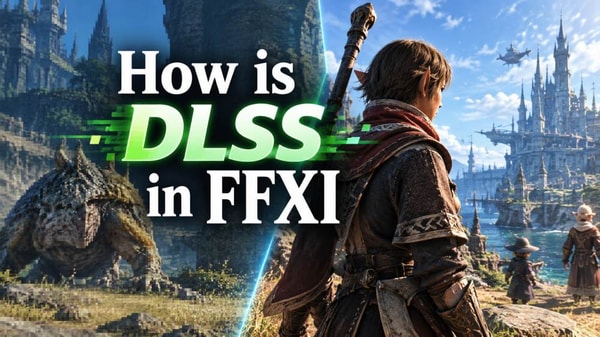
One recent experiment involves bringing DLSS 5 effects into FFXI through community-developed tools. The results are mixed: certain character models, enemies, and pieces of equipment can look significantly more detailed, but visual artifacts, motion issues, and substantial performance costs remain. This guide, shared by Huntin 4 Games, explains what DLSS 5 does, how it was brought into FFXI, the setup requirements described in the experiment, and the main advantages and limitations discovered during testing.
Looking for more ways to make your adventures in Vana'diel more convenient? Alongside exploring new graphics options, players can check out MmoGah's FFXI Gil service for an additional option when preparing for in-game purchases and other adventures.
What Is DLSS 5?
Deep Learning Super Sampling (DLSS) is NVIDIA's collection of AI-based graphics technologies. Earlier versions focused on rendering and upscaling techniques to improve image quality and performance. Later generations introduced additional features, including frame generation and ray reconstruction. DLSS 5 takes a different approach to visual enhancement by using AI to modify the appearance of rendered frames. Its effects can be adjusted to produce different visual results, ranging from subtle improvements to more dramatic changes.
For FFXI players, the idea is particularly interesting because the game was originally developed for older hardware and uses an older graphics pipeline. Players have long improved its appearance by increasing background resolution beyond the display resolution. DLSS 5 represents another possible way to enhance the game's visuals, although it was not designed to work directly with FFXI.
There are two important limitations to consider
- Game compatibility: FFXI does not support DLSS 5 natively, so additional tools and rendering workarounds are required.
- Performance cost: The experimental implementation can significantly reduce performance, making it difficult to justify for everyday gameplay.
NVIDIA's stated hardware availability for DLSS 5 is also limited to its RTX 50-series graphics cards, while community experimentation has explored ways to make the technology work on other NVIDIA GPUs.
How to Get DLSS 5 Working in FFXI
Getting DLSS 5 running in FFXI is considerably more complicated than enabling a graphics option in a modern game. The experiment uses several tools to bridge the gap between FFXI's older rendering system and the requirements of newer graphics effects. The setup described in the experiment includes:
- dgVoodoo: Used to route the game's original DirectX 8 rendering through a newer graphics interface, such as DirectX 11, DirectX 12, or Vulkan.
- ReShade: Provides a framework for applying post-processing effects.
- DLSS 5 add-on: Supplies the experimental DLSS 5 functionality.
- DLSS Feeder: A ReShade plugin used as part of the workaround.
- Motion interpreter: Helps address the motion information required by the rendering effects.
FFXI was originally built around DirectX 8 and a 32-bit architecture. Its original rendering pipeline does not provide all the information that modern AI-driven graphics effects expect. As a result, this setup involves translating or reconstructing certain rendering data rather than simply enabling native support. Similar challenges have appeared when applying ray tracing shaders to older games. Effects such as these can depend on information including motion vectors and scene depth, which may not be available in the format required by modern tools.
Important: This is an experimental configuration, not an official FFXI graphics feature. The setup may require troubleshooting, and the results can vary depending on the configuration and hardware.
DLSS 5 in FFXI: Main Visual Problems
Despite its potential, the experiment revealed several problems that affect image quality and gameplay.
1. Ghosting and Motion Artifacts
One of the most noticeable issues appears when characters move. At lower resolutions, the effects can struggle to keep up with in-game motion, creating a ghosting effect around moving objects. For example, the character's head may appear to leave a visual trail as it moves up and down. This issue was less noticeable at 1080p during the experiment, suggesting that the higher resolution may provide more image information for the effects to process. However, increasing the resolution also makes the performance cost more difficult to tolerate. This creates a trade-off between visual stability and playability.
2. Inconsistent Results on Faces and Environmental Textures
DLSS 5 does not improve every element of FFXI equally. The game's older textures and character models can be difficult for modern AI-driven image processing to interpret. Faces are a particular challenge. The technology may not consistently recognize the facial features of stylized characters. As a result, the enhancements do not always produce the kind of realistic facial detail seen in demonstrations involving newer games. Environmental objects can also be misinterpreted. Rocks and other older textures may not receive the intended improvements because their original visual information is limited. These results highlight an important limitation: AI-based visual enhancement depends partly on how well the technology can interpret the original image.
3. Excessive Shine and Wet-Looking Surfaces
Another issue comes from the lack of certain texture data in FFXI. Modern games commonly include specular information that helps determine how surfaces respond to light and how reflective they should appear. Older assets in FFXI do not always contain this information. When DLSS 5 attempts to enhance these surfaces, the results can look unnaturally shiny. Ground textures may appear wet or reflective even when the environment should not look that way. The effect can be visually impressive in some situations, but it does not always match the original game's intended appearance.
4. Floating Environmental Textures
Distant textures and environmental elements may appear to float or shift unnaturally. The exact cause was not established during the experiment, although the issue may be related to the configuration or the difficulty of reconstructing motion information from an older rendering pipeline. Reducing the intensity of the effects can help, but it does not necessarily eliminate the problem. Because FFXI was not designed with these modern rendering techniques in mind, some artifacts may remain difficult to resolve even as the tools improve.
5. Shimmering and Heavy Performance Loss
The experiment also revealed shimmering and other visual artifacts, particularly when the enhancement settings were increased significantly. At lower settings, the visual improvements were sometimes difficult to notice despite the performance cost. At higher settings, the effects became more obvious, but so did the artifacts and other image-quality problems. This makes tuning particularly challenging. Players must balance the intensity of the visual enhancements against image stability and frame rate.
What DLSS 5 Does Well in FFXI
Although the experiment exposed several limitations, some results were genuinely impressive.
1. More Detailed-Looking Equipment
Leather equipment was among the most convincing examples. DLSS 5 appeared to smooth and enhance the surfaces of certain pieces of gear, making them look more realistic. Some textures seemed to have more depth and material definition, creating the impression of leather that had been treated, stretched, or shaped into wearable equipment. These improvements offered a glimpse of how FFXI's existing assets might look through a more modern rendering approach.
2. Improved Enemy Appearance
Some enemy models also benefited from the experiment. Orc faces appeared more lifelike, while their equipment seemed to reveal additional detail. In the best moments, certain character models looked like more modern interpretations of their original designs. These changes were especially striking because the underlying assets had not been completely replaced. However, the improvements were inconsistent. A model might look impressive in one moment and show obvious artifacts as soon as it moved.
3. A Glimpse of FFXI's Visual Potential
The most interesting result is the possibility of presenting FFXI's original assets in a different way without rebuilding every model from scratch. The experiment suggests that AI-based rendering techniques could offer new options for enhancing older games. At the same time, the results demonstrate why stronger visual effects do not automatically produce a better overall experience. For a game with such a distinctive art style, preserving the original appearance is just as important as adding detail.
Is DLSS 5 Worth Using in FFXI?
Based on the experiment, DLSS 5 is an interesting technology to explore, but it is not yet an ideal way to play FFXI. H4G ultimately preferred the existing graphics configuration, which had already been customized with ambient occlusion and ray tracing plugins. One concern was that DLSS 5 offered less direct control over the final appearance, applying broad enhancements on top of the existing rendering process.
This does not mean the technology has no future in FFXI. Better tools, more effective configuration, and further development may improve the results. However, the experiment did not establish whether all the observed problems can be eliminated. For now, players who value a stable experience and control over FFXI's original visual style may prefer their existing graphics setup. Those interested in experimental rendering can still find value in testing DLSS 5, provided they are prepared for a complicated setup and inconsistent results.
Final Verdict
DLSS 5 offers an intriguing look at how modern AI-driven graphics technology might transform Final Fantasy XI. Its strongest moments make certain pieces of equipment and enemy models appear surprisingly modern, while its weaknesses expose the challenges of applying new rendering techniques to a game built for much older hardware.
The biggest obstacles are performance loss, motion artifacts, inconsistent texture interpretation, and the difficulty of balancing visual improvements against the original art direction. For FFXI, the most promising approach may be a lighter touch rather than maximizing every enhancement. Subtle improvements could preserve the game's recognizable style while making selected visual elements more appealing.
The experiment is a fascinating demonstration of what the community can accomplish with older games, but DLSS 5 still has a long way to go before it becomes a practical graphics solution for everyday FFXI gameplay.