The Quinfall’s 1.0 launch didn’t just add new content—it reset the economy. With a full wipe across world/characters/progression and inventories, everyone is rebuilding from zero, which creates the best “early economy” window for making The Quinfall gold coins fast if you play it smart.
This guide is designed for real players, not theorycrafters: you’ll learn what sells, why it sells, and how to turn your first few hours into a steady gold coins engine—without relying on exploits or low-value grinding. (And yes, recent patches also matter: the Central Market purchase issue was fixed, and Caravan risk/reward rules were updated, which changes how you should farm.)
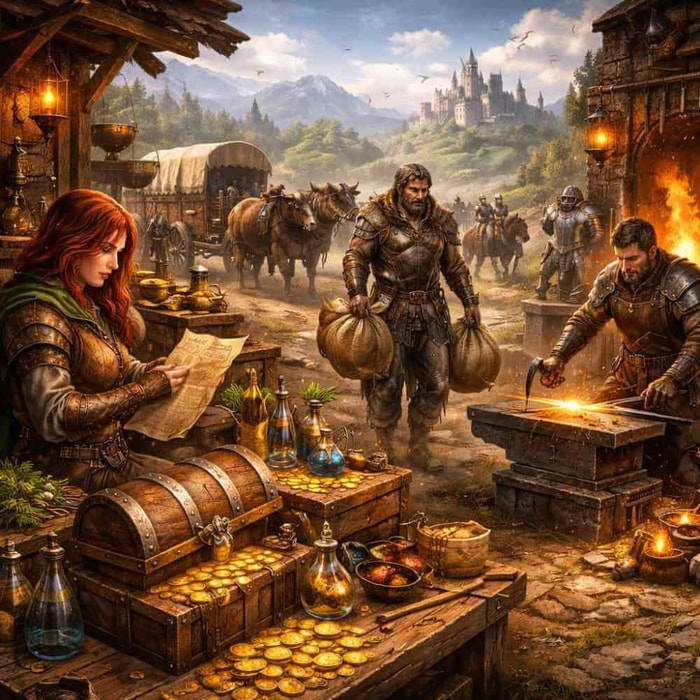
1. The “Fresh Economy” Rule: Don’t Farm What You Like—Farm What Everyone Needs
Right after a wipe, the market behaves the same in almost every sandbox MMO:
Demand spikes for:
Basic crafting materials (raw + refined)
Consumables (food, potions, arrows/ammo equivalents)
Upgrade/enhancement inputs (anything used to strengthen gear)
Travel/repair convenience items
Building resources (if housing/structures are active)
Supply spikes too—but unevenly. Most players gather randomly, hoard too long, or craft the wrong tier. Your advantage is choosing repeatable, always-buy items and selling them in the right format.
Your goal for the first week: become a supplier of “boring but unavoidable” goods.
2. Choose Your Money Path (Pick One First, Add Others Later)
Trying to do everything early usually slows you down. Pick one path for your first reliable income, then diversify.
Path A: Gatherer (fastest start, lowest risk)
If you want to get gold immediately, gathering is the cleanest start. Your edge is not “rare nodes”—it’s:
Short routes
High uptime
Selling fast in the right stack sizes
Best for: solo players, casual play sessions, anyone undergeared.
Path B: Crafter (higher margin, needs planning)
Crafting becomes profitable when you stop crafting “cool items” and start crafting inputs other people need:
Refined materials
Consumables are used every session
Common upgrade components
Best for: players who enjoy economy play and consistent profit.
Path C: Market Trader (highest upside, requires discipline)
Trading is about:
Buying underpriced listings
Reposting in better stack sizes
Selling at high-demand times
This got more reliable now that Central Market purchasing issues were patched, so trading is smoother than it was during the buggy period.
Path D: Caravan Runner (best “burst income,” flexible risk)
Caravans are your high-leverage gold option—but only if you choose the right channel and prep properly. Recent patch rules matter a lot here (see section 5).
3. Gold Coins Plan (Works Even If You Don’t Know the Meta Yet)
If you want a simple plan that “just works,” do this:
Step 1: Gather for 30–60 Minutes, Then Sell Immediately
Do not hoard early. In a fresh economy, early sales are worth more than perfect prices because:
You’re converting time into liquid gold
You can reinvest faster (tools, travel, crafting inputs)
Step 2: Sell in Smart Stack Sizes
Most buyers don’t want 1 unit and don’t want 999 units either. Try:
Small stacks for casual crafters
Medium stacks for steady production
Keep one or two large stacks if you see big-volume demand
Step 3: Reinvest in Speed, Not Power
Early on, your best “upgrade” is anything that improves:
Movement
Carry weight/inventory efficiency
Gathering speed
Crafting throughput
Power spikes are tempting, but if you spend all the coins on gear too early, you slow your income engine.
4. Central Market: How to Make Gold Coins Even When Prices Are Chaos
The market is unstable. That’s good—instability is profit.
Recent patch notes confirm a fix where items could not be purchased in certain situations, which means your listings are less likely to sit unsold due to system friction.
The 60-Second Market Scan (do this before you list)
Before listing an item, check:
Lowest price per unit (ignore obvious trolls)
How many listings exist (thin markets move fast)
Whether prices jump sharply between listings (signals shortage)
Undercut Rule: Don’t Race to the Bottom
If you undercut heavily, you kill your own profits and teach the market to be cheaper.
Instead:
Undercut by the smallest meaningful amount
Or match price and win via better stack size
Timing Rule: Sell When Players Craft
You’ll notice demand peaks:
After patch drops/resets
During prime time
When people hit a new tier and mass-craft upgrades
List your “core goods” during those windows.
“Processing Margin” Trick (beginner-friendly)
If raw material A sells for X, and refined material B sells for 2X, refining is only profitable if:
Your refining time is short
The market actually moves B consistently
Test with one batch, then scale. Don’t commit all materials until you see sales velocity.
5. Caravan Gold: Safe Consistency vs High-Risk High-Reward
Caravans are one of the best ways to turn structured play into gold—but the channel rules define your real profit.
Patch 1.0.0.3 changed Caravan behavior:
Caravan attacks are prevented in PvE Channels (and the previous 5% PvE bonus was removed)
Attacks are allowed in PvP Channels, with the bonus updated to 20%
What This Means in Practice
PvE Channel Caravans = steady income, lower stress
Best if you’re solo, undergeared, or learning routes
Your goal is consistency: more completed runs per hour
PvP Channel Caravans = higher upside, real risk
The 20% bonus is attractive, but losing a run can erase your gains
Only worth it if you can protect the run (group/escort, scouting, timing)
Caravan Optimization Checklist
No matter the channel:
Run light: don’t overload with unrelated loot that slows you
Plan your path: avoid obvious choke points if possible
Time your run: off-peak hours reduce interference
Treat your first runs as data: track time-to-complete and net profit
Rule of thumb: If you fail more than ~1 in 5 PvP-channel runs, you’re probably better off doing PvE-channel runs until your survival and scouting improve.

6. The “Gold Loop” That Scales Into Week 2–3
Once you have basic liquidity, stop thinking in single activities and build a loop:
Loop A (safe, solo-friendly)
Gather → refine → list → restock → repeat
Keep listings rolling
Avoid crafting niche gear unless it consistently sells
Loop B (balanced)
Gather + craft consumables → list → occasional Caravan runs (PvE channel) → reinvest
Consumables create repeat customers
Caravans give bursts of income that fund upgrades
Loop C (high-profit, group-enabled)
Market trading + PvP-channel Caravans + dungeon/world content (if profitable loot exists)
Requires coordination
Best for players who can protect runs and control downtime
7. What NOT to Do (These Mistakes Keep Players Poor)
Mistake 1: Hoarding “for Later”
After a wipe, “later” often means the market gets flooded, and your item loses value. Sell early unless you have a clear reason to hold.
Mistake 2: Crafting Expensive Gear Before You Have Buyers
Early crafters often burn all their materials on gear they personally want. That’s fine for gameplay—but it’s a bad business move unless you know it sells.
Mistake 3: Farming Risky Content Without Tracking Profit
If you can’t explain your average gold coins per hour, you’re guessing. Track:
Time spent
Net gold gained
Fail rate (for caravans / risky runs)
Mistake 4: Overcommitting to PvP-channel Caravans Too Early
The patch made PvP-channel Caravans more rewarding (20% bonus), but also explicitly allows attacks. Treat it like an “advanced” income strategy, not your starter plan.
8. Quick Checklist: Build Steady Quinfall Gold Without Wasting Time
If you want a simple system to follow:
Build a baseline income with gathering + market sales
Sell early in smart stack sizes
Reinvest in speed/efficiency upgrades
Start refining only after you confirm the refined product sells
Use PvE-channel Caravans for consistent coins while learning
Switch to PvP-channel Caravans only when you can protect runs (and accept losses)
Final Thoughts
The Quinfall’s 1.0 wipe created the most valuable type of economy: a fresh one where early suppliers can snowball. With the Central Market purchase issue fixed and Caravan rules clearly split between PvE safety and PvP bonus risk, the best gold coins farmers aren’t the ones grinding hardest—they’re the ones choosing the right loop for their gear level and playtime.