Unlike most MMOs, crafting in Aion 2 allows you to obtain BiS gear. That means these crafted items are better than anything you can get from defeating bosses. Since I'm taking a slower approach to gearing my character and not whaling, I wanted to show you guys the best way to do it. Even if you are whaling, however, this is still the most efficient way to acquire your gear.
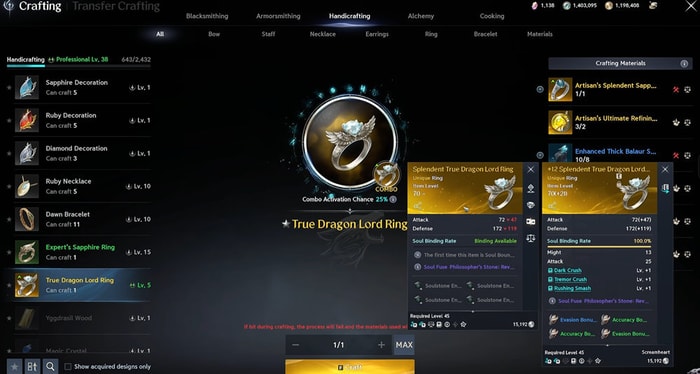
I have the Splendent True Dragon Lord Ring, and it's an item I'll never replace. Even when new content is released, this ring can be upgraded and remain relevant throughout future progression. If we open the crafting menu by pressing Esc and selecting Crafting, or simply by pressing Alt + G, you'll see several different crafting categories available.
What Should I Craft?
The main crafting category I recommend starting with is Handicrafting, as it provides access to most of your accessories. If you play a class like Chanter, you can also craft your weapon through this profession.
As I mentioned earlier, the Splendent True Dragon Lord Ring is one of my BiS items, and it's likely something I'll be using for a very long time. The reason I prioritized crafting rings is that they can provide bonus skill levels to your abilities. For example, my ring grants +1 to three different skills, including one of my primary skills. Because of that, it's an incredibly valuable piece of gear.
If you'd like a step-by-step demonstration of the crafting process, I highly recommend checking out Screamheart's video, where he shows exactly how to craft this ring.
Early Crafting & Leveling Strategy
When you first start crafting, you'll only have access to the basic materials and recipes. I highly recommend crafting the base materials repeatedly until you reach level 50. You can check your crafting level at the top of the crafting window. As you craft items, you'll gain experience, and before long you'll hit level 50.
Once you reach level 50, you'll unlock a quest that allows you to progress beyond the initial cap. As you can see, I'm currently Professional Level 38, which means I completed the level 50 advancement quest and have gained 38 levels beyond that point.
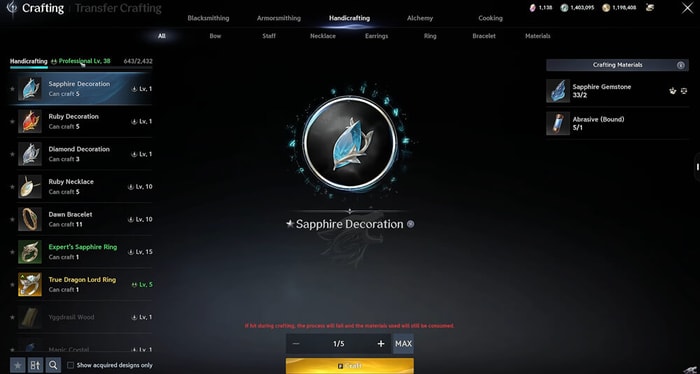
Whenever you select an item to craft, the required materials are displayed on the right side of the screen. Most recipes require resources gathered from the open world, along with one or two additional materials that can usually be purchased from vendors.
A useful tip that applies to almost everything in Aion 2 is to pay attention to the information panel whenever you click on an item. For example, the Source tab shows where the item comes from. In this case, we can see that it can be purchased from the Handicrafting Merchant located in the starter town. The tooltip also shows another vendor located in a different city.
Interestingly, the tooltip doesn't mention this, but subscribers can also purchase these materials from anywhere. Simply open the Shop, go to the Wind Breeze Merchant, and then navigate to Handicrafting Materials. This is a huge convenience because it eliminates the need to travel back and forth between cities.
Let me quickly demonstrate a basic craft before we talk about the best ways to obtain materials.
When Crafting begins, you'll see two progress bars. One represents your success chance, while the other represents the chance to fail. Naturally, the higher your crafting skill level, the greater your chance of success. However, even at higher skill levels, there is still a possibility that a craft can fail.
Gathering: How It Works & Is It Worth It?
If you press Esc and open the Essence Extraction tab, you'll find the game's gathering profession system.
Personally, I don't think gathering is the most efficient way to obtain materials for Crafting, especially on established servers. Early in a server's life, however, gathering can be extremely profitable because resources are in high demand and competition is still relatively low. As the server matures, more players begin farming the same nodes, and bots often enter the market as well, making gathering much less efficient.
That said, there are still a few important tips that can make the process more worthwhile.
First, I highly recommend investing points into Proficient Handling and Delicate Touch. For Lady Luck, I personally only put five points into it. The reason is that Lady Luck only becomes useful when your failure chance starts getting relatively high, usually above the 50% mark. I'd rather invest points into bonuses that provide more consistent results.
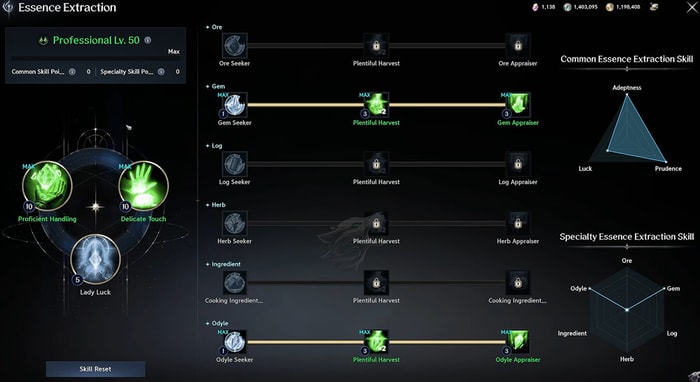
As you gather resources, you'll earn experience and gain points to improve these gathering talents. Just like crafting professions, gathering also has level caps. Once you reach certain milestones, you'll unlock advancement quests that allow you to continue leveling beyond the current cap.
When choosing which gathering specialization to level, focus on the materials that support your crafting profession. For example, Blacksmiths will likely want to prioritize Ore, while I focus on Gems because I'm specializing in Handicrafting.
For most players, I also recommend investing in Odyles as a secondary gathering specialization. Odyles are used in a large number of recipes and are also required for producing resources related to your weekly crafting limits.
You can see this in the Substance Morph menu. Although that's a separate system from gathering, it's worth mentioning because you can craft Odyle Energy there, and production is limited on a weekly basis. Because of their broad utility, Odyles tend to retain their value throughout progression.
To make gathering more efficient, I strongly recommend using one of the community-created resource maps available online. These maps show the locations of gathering nodes and can significantly reduce the amount of time spent searching.
When you interact with a gathering node, the process works similarly to Crafting. You'll have both a success chance and a failure chance, and the outcome depends on your gathering skill level and talents.
In this example, we successfully gathered a Pure Sapphire Gemstone, which is a higher-rarity material and generally sells for significantly more Kina than common resources. This is where gathering can become quite profitable.
As your Essence Extraction level increases, you'll unlock additional gathering perks. For example, the basic Gem specialization eventually allows gem nodes to be displayed on your minimap. This feature can be toggled on or off in the minimap settings, although most players will probably want to keep it enabled since it makes locating resources much easier.
The Best Way to Get Kina and Crafting Materials
While gathering can provide some extra income, it's not the primary method I recommend for making Kina or obtaining crafting materials.
Instead, I strongly recommend pet farming.
As you're killing enemies, you'll naturally earn Aion 2 Kina, progress your pet completion, and most importantly, gain chances at valuable item drops. While rare drops aren't guaranteed, they're common enough that farming mobs at max level can be extremely profitable over time.
For example, unique-grade items often sell for a substantial amount of Kina on the marketplace. Some pieces can easily sell for over one million Kina, making them a reliable source of income.
The great thing is that these drops aren't restricted to a specific location. In my experience, once you reach max level, virtually any endgame enemy has a chance to drop valuable items. Because of that, the most efficient strategy is simply to maximize your kill speed, complete your pet collections, and farm as many enemies as possible.
You'll also receive lower-rarity drops along the way. For example, I just picked up a green-quality item. By clicking the market search icon, I can quickly check its value. This particular item is only worth around 30,000 Kina, so selling it usually isn't worthwhile.
Instead, I prefer salvaging items like these.
Salvaging contributes to other progression systems, including the wardrobe and skin collection systems that provide permanent character stats. As a result, you're progressing multiple systems simultaneously while farming.
In addition to valuable unique equipment, you'll occasionally obtain crafting materials such as Refining Stones. These can be incredibly valuable on the marketplace and are often one of the biggest bottlenecks in the crafting process.
Interestingly, some lower-tier Refining Stones can actually sell for more than higher-rarity versions due to player demand. That's why it's always worth checking current market prices before selling anything.
Ultimately, the strategy is simple: farm enemies as efficiently as possible, sell valuable drops, salvage low-value items, and reinvest your profits into Crafting. If you're playing a class with strong AoE damage or exceptional farming speed, this method becomes even more effective.
A Huge Bonus Tip
Before we get into the actual crafting process and how to make the highest-tier items, I want to share one more extremely useful tip.
As I mentioned earlier, Refining Stones are one of the most expensive and important crafting materials in the game. Fortunately, you can obtain additional Refining Stones through the Achievements system.
If you open the Achievements menu and navigate to Resources & Crafting, you'll find a variety of rewards tied to crafting progression. Simply leveling up a profession such as Handicrafting will earn you some of these valuable materials.
However, here's the trick:
You don't have to limit yourself to a single crafting profession.
In many cases, it's worth leveling other professions purely for the achievement rewards, even if you never intend to use those professions long-term.
At first glance, this might seem expensive, but let's look at an example.
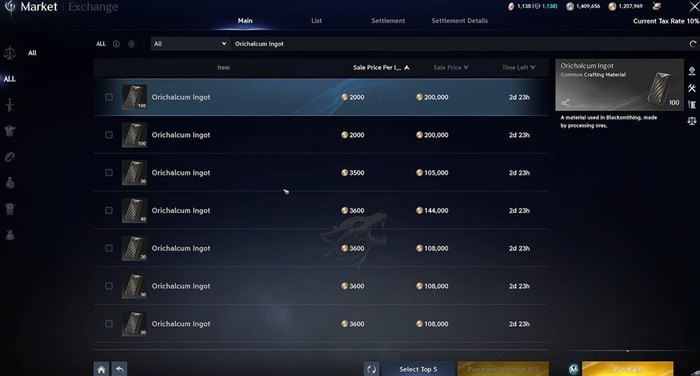
Suppose we're leveling Blacksmithing and crafting Orichalcum Ingots.
An Orichalcum Ore currently costs about 1,300 Kina, while Solvent costs around 400 Kina. Since each ingot requires two Orichalcum Ore and one Solvent, the total crafting cost comes to approximately 3,000 Kina per ingot.
If we check the marketplace, however, Orichalcum Ingots are generally selling for around 3,500 Kina.
That means you're either making a small profit or breaking even while gaining profession experience.
The strategy is simple:
1. Purchase the cheapest crafting materials available.
2. Convert them into higher-tier materials.
3. Sell the finished product back on the marketplace.
4. Earn profession experience and achievement progress in the process.
Even if the profit margin is small, the real value comes from the rewards you receive while leveling.
Effectively, you're gaining Artisan's Stones at little to no net cost, while also progressing completion achievements, unlocking future crafting milestones, and stockpiling materials that may become useful later.
In other words, if you're planning to craft BiS gear anyway, leveling secondary professions can be one of the most cost-effective investments you make.
How to Craft a BiS Item
Now let's look at how the actual crafting process works.
Whenever you craft one of these rings, you first need to successfully complete the craft itself. Then, if the craft succeeds, there is a 25% chance that the item will be upgraded to the next rarity tier.
Because of this system, most attempts will not advance to the next stage. In practice, roughly 75% of successful crafts remain at their current rarity, meaning you'll need multiple attempts to work your way up the crafting chain.
On top of that, you also have to account for your base crafting success rate. Fortunately, as your profession level increases, your chances improve significantly.
For example, if we look at this ring and check the Expected Probability window, my chance to successfully craft it is currently 93.1%. For the True Dragon Lord Ring, my success rate is 91.5%.
Those odds are fairly good, but failures can still be painful because of the material cost involved.
When I last calculated it, the total material cost for this crafting path was around 15 million Kinah in Aion 2, while the finished ring was selling for roughly 38 million Kinah on the marketplace. With a success rate above 90%, the potential return is still very attractive despite the risks.
Let's walk through the crafting progression.
The process begins with the base ring. If the craft succeeds and the 25% rarity upgrade triggers, you'll obtain the next-tier version. That upgraded ring then becomes a required ingredient for the next recipe.
For example:
- Green Ring → chance to upgrade into Blue Ring
- Blue Ring → chance to upgrade into Gold Ring
- Gold Ring → used to craft the endgame version
- Endgame Ring → 25% chance to become a Splendent version
This is why I always recommend crafting the entire progression chain yourself rather than purchasing higher-tier materials from the marketplace.
While buying intermediate materials may save time, it's often more expensive than crafting them yourself. More importantly, crafting each stage provides valuable profession experience, which increases your crafting level and improves your future success rates.
At the moment, this green recipe requires the green ring along with several additional materials. If it upgrades successfully, we'll get a blue ring. The blue ring can then be used to attempt the gold version, and the gold version eventually leads to the final BiS item.
Technically, once you've crafted the standard endgame version, you've already secured your BiS piece because it can later be upgraded into the Splendent version. The Splendent variant simply represents the best possible version of that item.
Material Sourcing Tip
One final note regarding crafting materials.
Before purchasing anything, always check the marketplace to compare prices. You can also click on individual materials and inspect their Source information to see where they come from.
For example, during my first attempt, I used Wrathful Mind purchased from the Season Shop. Looking back, that was probably a mistake. In hindsight, I should have used those resources to craft Mysterious Crystals instead.
I originally thought I was saving money, but after doing the math, crafting the materials myself would have been the more efficient option.
Final Thoughts
Crafting may seem overwhelming at first, but it's currently one of the most profitable and rewarding systems in Aion 2. By combining efficient farming, smart market decisions, and steady profession progression, you can significantly reduce the cost of crafting your BiS items. Just remember: treat crafting as a long-term investment, not a sprint. The players who stay consistent will eventually come out ahead.